
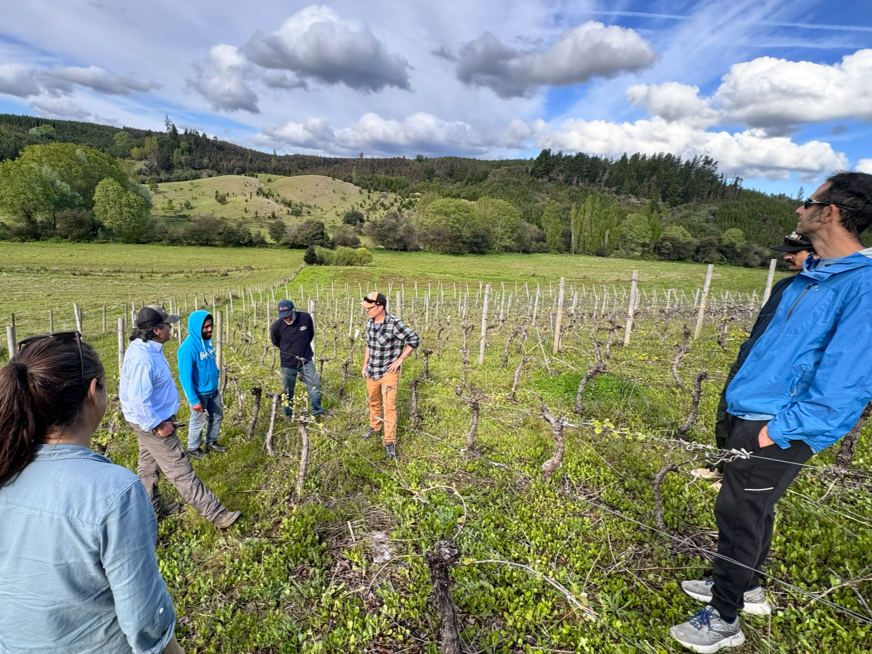
A UC Merced delegation recently traveled to Chile as part of an international collaboration through the AgAID AI Institute, a USDA-NIFA–funded initiative led by Washington State University. UC Merced serves as a key subawardee on the project, with Dr. Josh Viers as Principal Investigator. The team—Dr. Josh Viers, Dr. John Abatzoglou, Dr. Lauren Parker, Andres Morande, and Jack Severson— met with leading agricultural researchers and industry professionals across Chile.
This trip was designed to strengthen international partnerships and open new avenues for collaboration between researchers and students working to advance agricultural innovation. Chile offers a unique opportunity for collaboration, serving as both a latitudinal and climatic mirror of California and the U.S. West Coast. By aligning research efforts across hemispheres, scientists can effectively extend the growing season year-round, accelerating progress on climate-smart agriculture.


The UC Merced team focused particularly on viticulture, a shared high-value specialty crop in Chile, California, and Washington. The group visited vineyards and research sites across four major agricultural regions, gaining insights into the diverse climate and water challenges faced by grape growers—from the cool, wetter southern regions where cultivation is expanding into new territory, to the hotter, drier northern zones where heat and drought stress increasingly shape production.
The delegation also met with research teams at Universidad de Talca and Pontificia Universidad Católica de Chile, along with scientists at the Viña Concha y Toro Center for Research and Innovation. These engagements helped establish a foundation for ongoing research partnerships that will contribute to developing sustainable, technology-driven farming solutions across continents.
The AgAID Institute’s partnership with Chile’s Pontificia Universidad Católica builds on shared goals to advance data-driven agricultural management through artificial intelligence. This collaboration focuses on modeling climate impacts on specialty crops, particularly winegrapes, and improving water-use intelligence across comparable growing regions in the Western Hemisphere. By integrating field insights from Chile with AI-enabled modeling tools developed in the U.S., researchers aim to refine forecasts of water availability and crop suitability under future climate conditions. The partnership also supports student exchanges and hands-on research opportunities, ensuring the next generation of scientists is equipped to apply emerging technologies to global agricultural challenges.

All photo credit to Josh Viers